
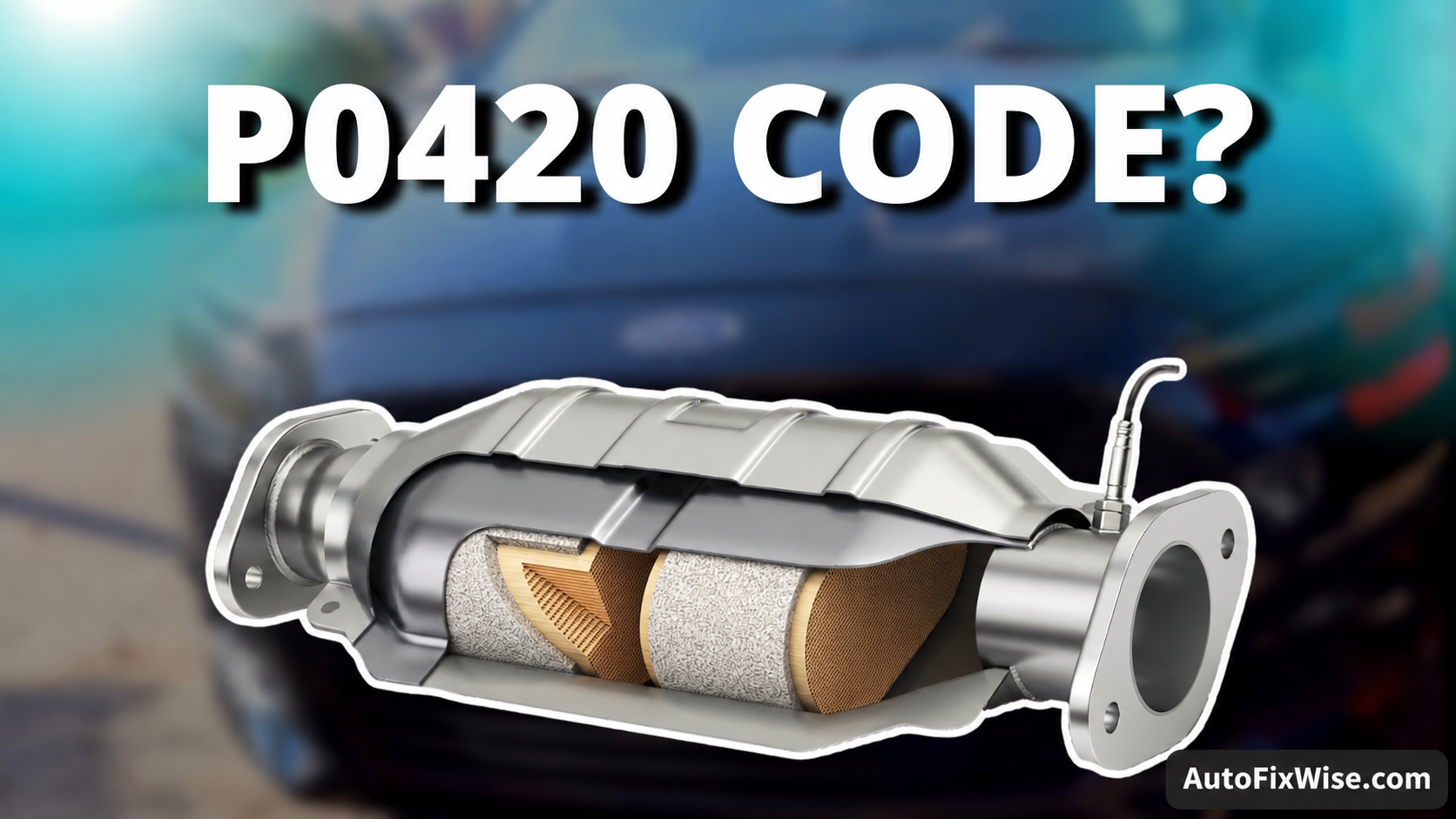
A P0420 code means the engine control module has detected that the catalytic converter on Bank 1 is not reducing exhaust emissions as efficiently as expected. A worn catalytic converter is a common cause, but exhaust leaks, oxygen sensor problems, misfires, and incorrect fuel mixture can trigger the same code.
Do not replace the catalytic converter based on the code alone. A proper diagnosis can prevent an expensive and unnecessary repair.
What Does the P0420 Code Mean?
P0420 stands for “Catalyst System Efficiency Below Threshold (Bank 1).”
The catalytic converter changes harmful exhaust gases into less harmful emissions. The engine control module monitors its performance by comparing signals from oxygen sensors located before and after the converter.
The upstream oxygen sensor measures the exhaust leaving the engine. The downstream sensor monitors the exhaust after it passes through the catalytic converter.
When the converter is operating correctly, the downstream sensor signal should normally be more stable than the upstream signal. If the computer determines that both sensors are behaving too similarly, it may conclude that the converter is no longer storing oxygen and processing emissions efficiently enough.
“Bank 1” refers to the side of the engine containing cylinder number one. An inline engine normally has only one bank. Engines with two cylinder banks may also set P0430, which refers to catalyst efficiency on Bank 2.
P0420 Code Quick Summary
- Code definition: Catalyst System Efficiency Below Threshold
- Affected side: Bank 1
- Common cause: Degraded or contaminated catalytic converter
- Other possible causes: Exhaust leaks, oxygen sensor faults, misfires, or fuel-mixture problems
- Typical warning: Check engine light
- Safe to drive: Sometimes for a short distance, depending on the symptoms
- Average repair range: Approximately $100 to more than $3,000, depending on the actual cause
Common Symptoms of P0420
Some vehicles display no noticeable symptoms other than an illuminated check engine light. Possible symptoms include:
- Check engine light
- Failed emissions inspection
- Reduced engine performance
- Poor acceleration
- Reduced fuel economy
- Sulfur or rotten-egg odor from the exhaust
- Excessive heat beneath the vehicle
- Rattling noise from inside the catalytic converter
- Additional misfire or fuel-mixture codes
A severely restricted or melted converter may cause major power loss, especially at higher engine speeds.
What Causes a P0420 Code?
1. Degraded Catalytic Converter
The most common cause is a catalytic converter that can no longer process exhaust gases efficiently.
Converters may deteriorate because of age and mileage, but an underlying engine problem can cause early failure. Excess fuel, engine oil, coolant, or prolonged misfires can overheat, contaminate, or melt the catalyst material.
Replacing the converter without correcting the original engine problem may cause the new converter to fail again.
2. Exhaust Leak
An exhaust leak near the exhaust manifold, flex pipe, flange, catalytic converter, or oxygen sensor can allow outside air to enter the exhaust stream.
The additional oxygen may alter sensor readings and make a functioning converter appear inefficient.
Small leaks may leave black soot around a joint or produce a ticking noise during a cold start.
3. Faulty Downstream Oxygen Sensor
A slow, biased, contaminated, or damaged downstream oxygen sensor may send inaccurate information to the engine control module.
However, an oxygen sensor should not be replaced simply because P0420 is present. Its wiring, connector, power supply, heater circuit, and live data should be tested first.
4. Engine Misfire
A misfire may send unburned fuel into the exhaust. The catalytic converter can become dangerously hot while attempting to process that fuel.
Codes such as P0300, P0301, P0302, and other cylinder-specific misfire codes should be diagnosed before addressing P0420.
A flashing check engine light often indicates an active misfire capable of damaging the catalytic converter. Reduce speed and stop driving as soon as it is safe.
5. Rich or Lean Fuel Mixture
Incorrect fuel mixture can reduce catalyst efficiency or damage the converter. Possible causes include:
- Vacuum or intake leaks
- Faulty mass airflow sensor
- Leaking fuel injector
- Incorrect fuel pressure
- Faulty engine coolant temperature sensor
- Evaporative-emissions system problem
- Contaminated air-fuel ratio sensor
- Intake or exhaust restriction
Fuel-trim and related mixture codes should be diagnosed before replacing the converter.
6. Oil or Coolant Consumption
An engine burning oil or leaking coolant into the combustion chambers can contaminate the catalytic converter.
Blue exhaust smoke, unexplained coolant loss, spark-plug deposits, or frequent oil consumption may indicate an underlying engine problem.
A replacement converter may fail again unless the source of contamination is repaired.
7. Wiring or Connector Damage
Heat, corrosion, road debris, and previous repairs can damage oxygen-sensor wiring or connectors. An intermittent signal may incorrectly influence catalyst monitoring.
8. Software or Calibration Issue
Some vehicles may have manufacturer technical service information or an engine-control software update related to catalyst-monitoring sensitivity.
This is less common than a mechanical or emissions-system problem, but vehicle-specific service information should be checked before expensive parts are replaced.
Is P0420 Always a Bad Catalytic Converter?
No. P0420 indicates that the computer believes catalyst efficiency is below the programmed threshold. It does not prove that the catalytic converter itself is the only possible cause.
A technician should first check for:
- Other stored or pending trouble codes
- Misfires
- Rich or lean operation
- Exhaust leaks
- Oxygen-sensor wiring damage
- Abnormal oil or coolant consumption
- Applicable technical service bulletins or software updates
If these issues are ruled out and live sensor data confirms poor catalyst performance, replacement may be necessary.
How Is P0420 Diagnosed?
A proper diagnostic process may include the following steps.
Step 1: Scan All Diagnostic Codes
Record stored, pending, and permanent codes along with freeze-frame data.
Misfire, oxygen-sensor, fuel-trim, airflow, or coolant-temperature codes may reveal the condition that triggered P0420.
Step 2: Inspect the Exhaust System
Inspect the exhaust manifold, gaskets, flex pipe, flanges, welds, converter, and sensor mounting points.
A smoke test or low-pressure leak test may help locate small exhaust leaks.
Never touch or inspect a hot exhaust system without appropriate equipment and safety precautions.
Step 3: Check Engine Operation
Confirm that the engine reaches normal operating temperature and runs without misfires, excessive oil consumption, coolant loss, or major fuel-trim problems.
The engine should operate correctly before catalyst efficiency is evaluated.
Step 4: Inspect Oxygen Sensors and Wiring
Check the upstream and downstream oxygen sensors, connectors, harness routing, heater circuits, and related electrical connections.
A sensor with damaged wiring or abnormal response may require further testing.
Step 5: Review Live Sensor Data
With the engine warm and operating in closed loop, compare upstream and downstream sensor activity.
A healthy converter generally smooths the downstream signal. A downstream pattern closely following the upstream pattern may indicate reduced oxygen-storage capacity, but the result must be interpreted according to the vehicle and sensor type.
Wideband air-fuel ratio sensors behave differently from traditional narrowband oxygen sensors.
Step 6: Test Catalyst Performance
Depending on the vehicle and available equipment, a technician may use:
- Scan-tool catalyst monitor data
- Oxygen-storage testing
- Exhaust-gas analysis
- Temperature comparison
- Pressure or restriction testing
- Manufacturer-specific diagnostic procedures
Temperature alone does not provide a complete diagnosis and should not be the only reason for replacing the converter.
How Much Does It Cost to Fix P0420?
The total cost depends on what caused the code. Approximate U.S. price ranges are:
| Possible repair | Estimated total cost |
|---|---|
| Professional diagnosis | $100–$220 |
| Repair a minor exhaust leak | $100–$400 |
| Oxygen sensor replacement | $200–$600 |
| Wiring or connector repair | $100–$500 |
| Fuel or ignition-system repair | $150–$1,000+ |
| Catalytic converter replacement | $1,000–$3,500+ |
| Engine repair for oil or coolant consumption | $1,000–$6,000+ |
These are general estimates, not guaranteed quotes. Prices vary by vehicle, location, labor rate, converter type, emissions certification, and the number of converters installed.
Original-equipment converters are often more expensive than aftermarket units. Vehicles registered in California or states that follow California emissions rules may require a converter approved for that exact vehicle application.
Before paying for a converter, check the vehicle’s emissions-warranty information. Depending on vehicle age, mileage, and applicable regulations, the original catalytic converter may still have warranty coverage.
Can You Drive With a P0420 Code?
A vehicle with a steady check engine light and no drivability symptoms may sometimes be driven a short distance to a repair facility.
Do not continue driving if you notice:
- Flashing check engine light
- Severe power loss
- Engine misfire
- Excessive exhaust heat
- Burning smell
- Red-hot catalytic converter
- Stalling
- Heavy smoke
- Loud exhaust leak
A flashing check engine light may indicate a misfire that can quickly overheat and damage the converter.
Even when the vehicle appears to run normally, P0420 can cause an emissions-test failure and should not be ignored.
Can a P0420 Code Clear Itself?
The warning light may turn off after several successful drive cycles if the condition does not return. The code may remain stored as a history or permanent code for a period of time.
Clearing the code with a scan tool does not repair the underlying problem. If the fault remains, the engine computer will run the catalyst monitor again and the code will return.
Will Catalytic Converter Cleaner Fix P0420?
A fuel additive cannot repair a melted, cracked, physically damaged, or chemically depleted catalytic converter.
Some products may temporarily affect deposits or combustion conditions, but they should not replace proper diagnosis. Be cautious of any product promising a guaranteed repair for P0420.
If contamination or engine operating problems caused the converter failure, the underlying problem must be corrected.
Can a Bad Oxygen Sensor Cause P0420?
Yes, a faulty or biased oxygen sensor can contribute to P0420, but it is not the most common explanation in every vehicle.
Sensor data, wiring, heater operation, exhaust leaks, and engine performance should be tested before replacing an oxygen sensor. Replacing both sensors without diagnosis can waste money and leave the original problem unresolved.
Can Bad Spark Plugs Cause P0420?
Worn spark plugs can cause misfires or incomplete combustion. Unburned fuel entering the exhaust can overheat and damage the catalytic converter.
Spark plugs do not usually set P0420 directly, but an unresolved ignition problem can create the conditions that cause catalyst failure.
How Do You Prevent P0420 From Returning?
To reduce the chance of another catalyst-efficiency code:
- Repair misfires promptly
- Address rich or lean mixture codes
- Fix exhaust leaks
- Use the correct engine oil
- Monitor abnormal oil or coolant consumption
- Maintain spark plugs and ignition components
- Use a converter approved for the vehicle
- Correct the original cause before installing a new converter
Related Diagnostic Codes
- P0430: Catalyst System Efficiency Below Threshold, Bank 2
- P0300: Random or Multiple Cylinder Misfire Detected
- P0171: System Too Lean, Bank 1
- P0172: System Too Rich, Bank 1
- P0136: Oxygen Sensor Circuit, Bank 1 Sensor 2
- P0141: Oxygen Sensor Heater Circuit, Bank 1 Sensor 2
The Bottom Line
P0420 means the engine computer has detected low catalytic-converter efficiency on Bank 1. A worn converter is a common cause, but replacing it without checking for exhaust leaks, sensor problems, misfires, fuel-mixture faults, and oil or coolant consumption can lead to an unnecessary repair or repeated failure.
Start with a complete scan and a careful inspection. Correct any engine or exhaust problem first, then confirm converter performance using vehicle-appropriate diagnostic procedures.
For vehicle-specific diagnosis, emissions requirements, and parts compatibility, consult a qualified technician and verify all components using the complete VIN.
6 thoughts on “P0420 Code: Meaning, Causes, Symptoms, and Repair Cost”