
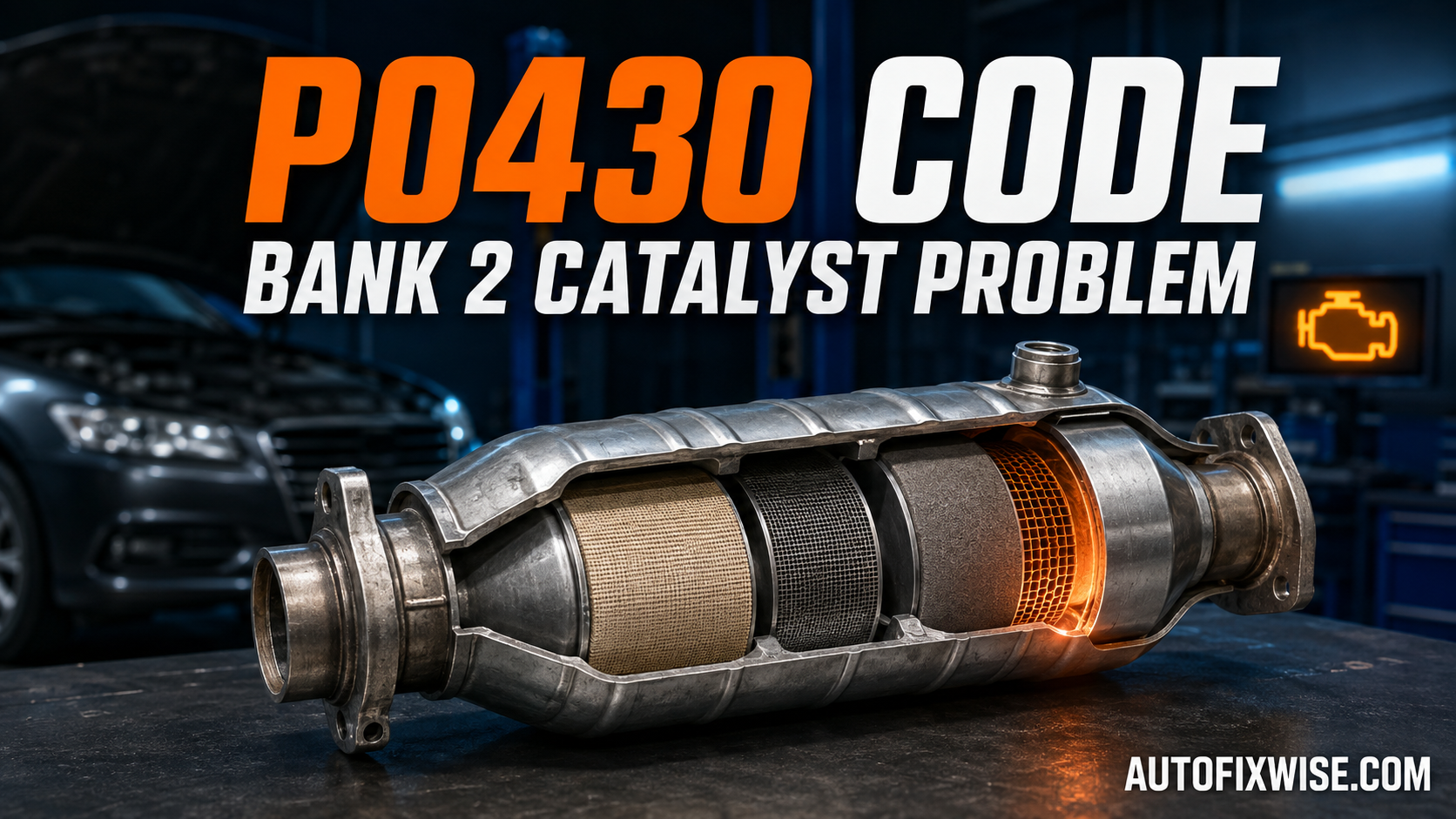
Seeing the check engine light come on can be stressful, especially when your diagnostic scanner displays the P0430 code. In many cases, this trouble code points to a problem involving the catalytic converter on Bank 2. However, it does not automatically mean that the catalytic converter must be replaced.
Exhaust leaks, faulty oxygen sensors, engine misfires, and incorrect fuel mixtures can produce similar results. Replacing the converter without diagnosing these problems first can lead to an expensive repair that does not solve the actual cause.
This guide explains what the P0430 code means, the symptoms you may notice, its most common causes, how the problem is diagnosed, and how much the repair could cost.
What Does the P0430 Code Mean?
The P0430 code means:
Catalyst System Efficiency Below Threshold — Bank 2
Your vehicle’s engine control module, commonly called the ECM or PCM, monitors the catalytic converter by comparing signals from oxygen sensors located before and after the converter.
The upstream oxygen sensor measures the exhaust gases leaving the engine. The downstream sensor helps the computer determine whether the catalytic converter is processing those gases effectively.
When the computer detects that the Bank 2 catalytic converter is not operating efficiently enough, it may store the P0430 code and illuminate the check engine light.
What Does Bank 2 Mean?
Bank 2 refers to the side of the engine that does not contain cylinder number one.
This distinction normally applies to V-shaped and horizontally opposed engines that have two cylinder banks. An inline four-cylinder engine has only one bank and will usually be associated with a Bank 1 catalyst code instead.
The location of Bank 2 depends on the engine design. It is not always the driver’s side or passenger’s side. Check the vehicle’s service information before replacing any sensor or catalytic converter.
P0430 vs. P0420: What Is the Difference?
P0430 and P0420 describe the same general type of catalyst-efficiency problem, but they apply to different sides of the engine:
- P0420: Catalyst efficiency below threshold on Bank 1
- P0430: Catalyst efficiency below threshold on Bank 2
If your scanner displays P0420 instead, read our complete guide to the P0420 code.
When both codes appear together, the problem may affect the entire engine rather than only one exhaust bank. Examples include an incorrect air-fuel mixture, contaminated fuel, or long-term misfires.
Common Symptoms of the P0430 Code
Some vehicles continue to run normally after storing P0430. Others may develop noticeable drivability or exhaust problems.
1. Illuminated Check Engine Light
The check engine light is often the first and only symptom. The computer may detect declining catalyst performance before the driver notices any change in how the vehicle runs.
2. Reduced Engine Performance
A damaged or restricted catalytic converter can reduce exhaust flow. The vehicle may feel sluggish, especially when accelerating or driving uphill.
3. Poor Fuel Economy
An engine or fuel-system problem that contributes to P0430 may also increase fuel consumption. You may notice that the vehicle travels fewer miles on a tank of fuel.
4. Rotten-Egg Smell
A sulfur-like or rotten-egg odor can indicate that the catalytic converter is struggling to process exhaust gases. Fuel quality and an excessively rich mixture can also produce this smell.
5. Rattling Noise Under the Vehicle
The internal catalyst material can crack or break apart because of overheating or physical damage. Loose material may create a metallic rattling sound, particularly during startup or acceleration.
6. Failed Emissions Test
A stored catalyst-efficiency code will commonly cause a vehicle to fail an emissions or inspection test. Clearing the code shortly before testing will not necessarily help because the emissions monitors need time to run again.
7. Excessive Exhaust Heat
A restricted or overheated converter can create unusually high temperatures beneath the vehicle. In serious cases, the converter may glow red.
If the converter is glowing, stop driving and have the vehicle inspected. Excessive exhaust temperatures can create a fire risk and cause further damage.
What Causes the P0430 Code?
Although converter failure is common, P0430 should not be treated as automatic proof that the converter is bad.
1. Worn or Damaged Catalytic Converter
Catalytic converters can lose efficiency as they age. Their internal material may become contaminated, melted, cracked, or physically damaged.
Normal age can contribute to failure, but converters are also damaged by unresolved engine problems. Installing a new converter without correcting the underlying cause may result in another failure.
2. Exhaust Leak
An exhaust leak near the manifold, pipe connections, catalytic converter, or oxygen sensors can allow outside air to enter the system.
This extra oxygen can alter sensor readings and make the computer believe the converter is not working correctly. Even a relatively small leak may affect the diagnosis.
3. Faulty Downstream Oxygen Sensor
The downstream oxygen sensor reports catalyst activity to the engine computer. A slow, contaminated, damaged, or electrically faulty sensor may provide inaccurate information.
However, replacing the downstream sensor based only on the P0430 code is not recommended. Its live data and electrical circuit should be tested first.
4. Faulty Upstream Oxygen Sensor
The upstream sensor helps control the engine’s fuel mixture. Incorrect readings can cause the engine to run too rich or too lean, affecting emissions and converter operation.
Sensor performance should be checked alongside fuel trims and other live diagnostic data.
5. Engine Misfire
A misfire can allow unburned fuel to enter the exhaust. When that fuel reaches the catalytic converter, it may cause extreme heat and damage the catalyst material.
Misfire codes such as P0300 or cylinder-specific P0301–P0308 codes should be repaired before addressing P0430.
6. Rich or Lean Air-Fuel Mixture
Faulty fuel injectors, vacuum leaks, incorrect fuel pressure, a contaminated mass airflow sensor, or other engine-management problems can disturb the air-fuel mixture.
A rich mixture may overheat the converter, while a lean-running condition can create excessive combustion temperatures and higher emissions.
7. Oil or Coolant Entering the Exhaust
An engine that burns oil or coolant can contaminate the catalytic converter. Possible causes include worn piston rings, valve-seal problems, a damaged head gasket, or an internal engine leak.
Blue exhaust smoke may indicate burning oil, while persistent white smoke and coolant loss can suggest coolant entering the combustion chambers.
How Serious Is the P0430 Code?
P0430 is usually considered a moderate problem, but its seriousness depends on the underlying cause.
If the vehicle runs normally and the check engine light remains steady, you can generally drive a short distance to a repair facility. Nevertheless, delaying diagnosis can make the repair more expensive.
Stop driving and arrange assistance if you notice:
- A flashing check engine light
- Severe loss of power
- Strong burning or sulfur odor
- A glowing catalytic converter
- Engine overheating
- Loud rattling from the exhaust
- Heavy blue, black, or white exhaust smoke
A flashing check engine light often indicates an active misfire that can rapidly damage the catalytic converter.
Can You Drive With a P0430 Code?
The vehicle may remain drivable when P0430 is the only code and there are no severe symptoms. However, continuing to drive for an extended period is not advisable.
A restricted converter can eventually reduce engine power or cause excessive heat. If an engine problem is sending unburned fuel into the exhaust, continued driving can destroy a converter that might otherwise have remained usable.
Treat the code as a warning to schedule a proper diagnosis rather than something to ignore.
How Is the P0430 Code Diagnosed?
A professional diagnosis should determine why catalyst efficiency appears low before any expensive parts are replaced.
Step 1: Scan All Trouble Codes
The technician checks for other stored, pending, and permanent codes. Misfire, fuel-trim, oxygen-sensor, or temperature-related codes may reveal the actual cause.
Freeze-frame information is also useful because it shows the engine conditions present when P0430 was stored.
Step 2: Inspect the Exhaust System
The exhaust manifold, gaskets, pipes, welds, flex sections, and converter connections should be checked for leaks and physical damage.
Loose heat shields can also create rattling noises that are sometimes mistaken for internal converter failure.
Step 3: Review Live Sensor Data
Upstream and downstream oxygen-sensor signals are compared while the engine is at normal operating temperature.
The exact signal pattern depends on the sensor type and vehicle. Diagnosis should follow the manufacturer’s procedure instead of relying on one universal voltage rule.
Step 4: Check Fuel Trims and Misfire Data
Abnormal fuel trims can point toward vacuum leaks, fuel-delivery problems, inaccurate airflow measurements, or failing sensors.
Misfire counters may reveal an intermittent combustion problem even when the driver has not noticed rough running.
Step 5: Test Converter Temperature or Oxygen Storage
Depending on the vehicle, a technician may use scan-tool tests, temperature measurements, exhaust-gas analysis, or manufacturer-specific procedures to evaluate the converter.
Temperature alone should not be used as absolute proof of converter condition.
Step 6: Check for Software Updates
Some manufacturers release technical service bulletins or engine-computer software updates for catalyst-monitoring concerns. The technician should check vehicle-specific service information before replacing major components.
Common Diagnostic Mistakes
The most expensive mistake is replacing the Bank 2 catalytic converter immediately after reading the code.
Other common mistakes include:
- Replacing oxygen sensors without testing them
- Ignoring exhaust leaks
- Clearing the code without checking freeze-frame data
- Overlooking misfires or incorrect fuel trims
- Installing a cheap converter that does not meet the vehicle’s requirements
- Failing to correct oil or coolant consumption
- Confusing Bank 1 with Bank 2
A scan code identifies the system that detected a problem. It does not always identify the failed part.
How Do You Fix the P0430 Code?
The correct repair depends on the diagnosis. Possible solutions include:
- Repairing exhaust leaks
- Replacing a faulty oxygen sensor
- Repairing damaged sensor wiring or connectors
- Correcting vacuum leaks
- Repairing ignition or fuel-system problems
- Replacing leaking fuel injectors
- Repairing engine misfires
- Correcting oil or coolant consumption
- Updating engine-control software when applicable
- Replacing the Bank 2 catalytic converter
P0430 Repair Cost
Repair prices vary according to the vehicle, labor rate, converter location, and underlying problem. Approximate U.S. price ranges are:
| Repair | Estimated cost |
|---|---|
| Diagnostic inspection | $100–$200 |
| Exhaust-leak repair | $100–$600 |
| Oxygen-sensor replacement | $200–$500 |
| Wiring or connector repair | $100–$400 |
| Ignition or misfire repair | $150–$1,000+ |
| Fuel-injector replacement | $300–$1,200+ |
| Catalytic-converter replacement | $1,000–$3,000+ |
| Internal engine repair | $1,500–$6,000+ |
These figures are general estimates, not guaranteed quotes. Original-equipment converters and vehicles with converters integrated into the exhaust manifold can cost considerably more.
Can a Catalytic Converter Cleaner Fix P0430?
A cleaner is unlikely to repair a converter that is melted, cracked, contaminated, or worn out. It also cannot fix an exhaust leak, defective sensor, wiring fault, or engine misfire.
Some products may temporarily affect deposits or sensor readings, but they should not replace diagnosis. If the code returns, the underlying problem still needs attention.
Will P0430 Clear Itself?
The check engine light may turn off after several successful drive cycles if the condition was temporary. However, the code can remain stored in the computer’s history.
If the converter, sensor, or engine problem still exists, the light will return. Disconnecting the battery or clearing the code only resets the warning; it does not repair the vehicle.
How Can You Prevent P0430?
Not every catalytic-converter failure is preventable, but good maintenance can reduce the risk.
- Repair misfires as soon as possible.
- Use the correct engine oil.
- Investigate unexplained oil or coolant loss.
- Replace spark plugs according to the maintenance schedule.
- Avoid driving with a flashing check engine light.
- Repair rich or lean fuel conditions promptly.
- Use the fuel grade recommended by the manufacturer.
- Make sure replacement exhaust components meet applicable requirements.
Frequently Asked Questions
Does P0430 always mean the catalytic converter is bad?
No. A worn converter is a common cause, but exhaust leaks, sensor faults, engine misfires, and air-fuel mixture problems can also trigger the code.
Which side of the engine is Bank 2?
Bank 2 is the side that does not contain cylinder number one. Its physical position varies by engine, so verify it using vehicle-specific service information.
Can a bad oxygen sensor cause P0430?
Yes. A faulty upstream or downstream oxygen sensor can contribute to P0430. The sensor and its circuit should be tested before replacement.
Can bad spark plugs cause P0430?
Worn spark plugs can cause misfires. Persistent misfires may send unburned fuel into the exhaust, overheat the converter, and eventually produce a catalyst-efficiency code.
Will P0430 cause poor acceleration?
It can. A severely restricted catalytic converter may limit exhaust flow and reduce acceleration. Many vehicles, however, display only a check engine light.
Can I pass an emissions test with P0430?
A vehicle with an active check engine light or incomplete emissions monitors will commonly fail an OBD-based inspection. Requirements vary by location.
Is P0430 expensive to repair?
It can be expensive if the catalytic converter requires replacement. If the cause is a small exhaust leak or wiring issue, the repair may cost substantially less.
Final Thoughts
The P0430 code indicates that the engine computer has detected low catalyst efficiency on Bank 2. Although a worn catalytic converter is a likely possibility, it is not the only explanation.
Exhaust leaks, oxygen-sensor problems, misfires, incorrect fuel mixtures, and internal engine issues should be ruled out first. Proper diagnosis is especially important because catalytic converters are expensive and may fail again if the original engine problem remains unresolved.
If the check engine light is flashing, the converter is glowing, or the vehicle has lost significant power, stop driving and have it inspected immediately.