
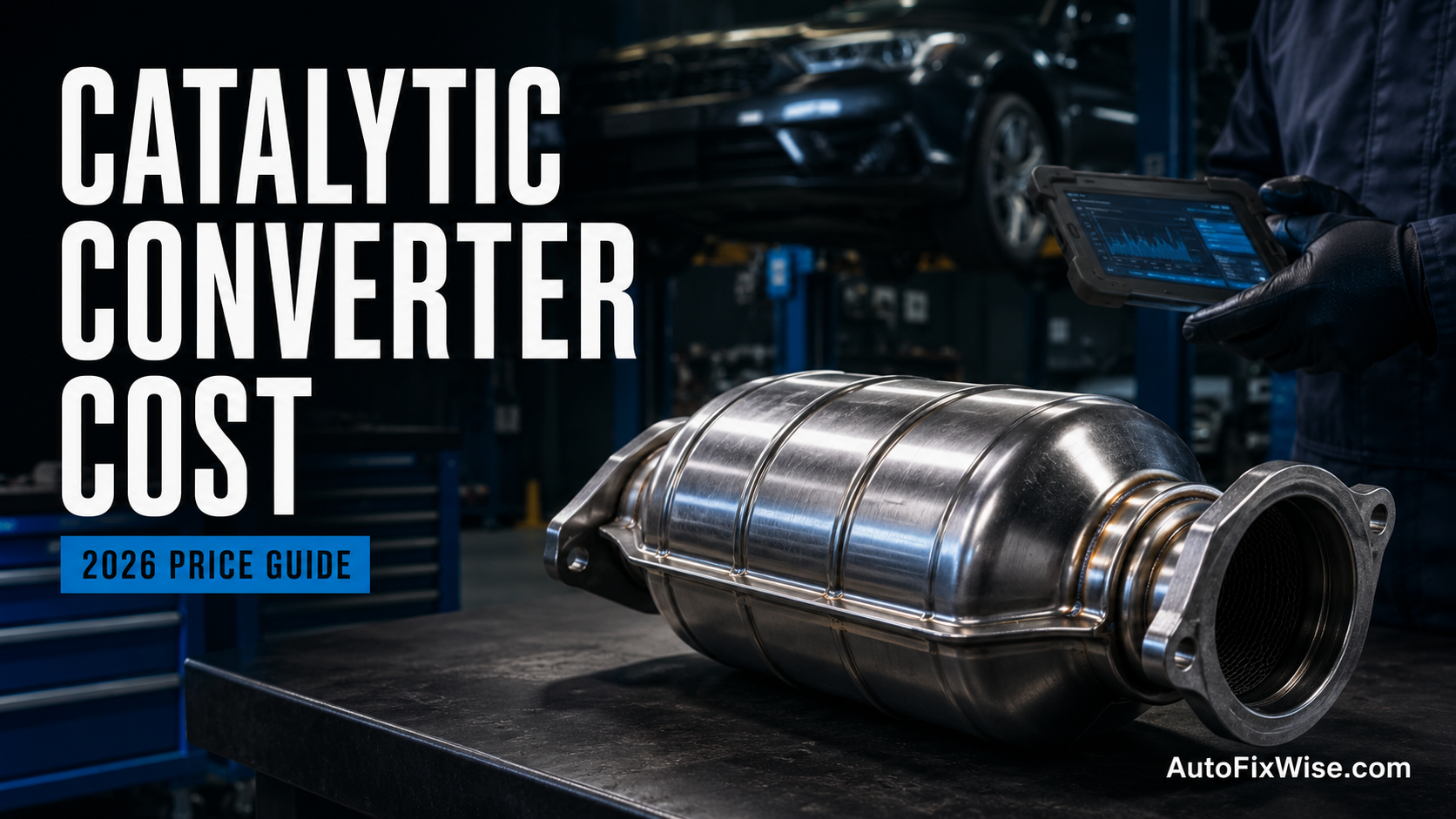
How Much Does a Catalytic Converter Replacement Cost in 2026?
A catalytic converter replacement cost typically ranges from $1,000 to $3,500 in the United States, including parts and labor. However, a simple aftermarket replacement may cost less than $1,000, while some luxury, hybrid, high-performance, and multi-converter vehicles can exceed $4,000.
The final price depends on the vehicle, converter type, labor rates, emissions requirements, and whether additional exhaust repairs are needed. Before approving the repair, it is important to confirm that the catalytic converter has actually failed—and determine what caused it to fail.
Average Catalytic Converter Replacement Cost
The following figures provide a general estimate for 2026. Actual prices vary by vehicle and location.
| Repair or Service | Estimated Cost |
|---|---|
| Diagnostic inspection | $100–$220 |
| Aftermarket converter, part only | $300–$2,500 |
| OEM converter, part only | $1,000–$4,000+ |
| Labor for a straightforward installation | $150–$600 |
| Typical total replacement | $1,000–$3,500 |
| Luxury, hybrid, or multi-converter vehicle | $3,000–$6,000+ |
| Repairing a damaged exhaust flange or pipe | $100–$700+ |
These are general estimates rather than guaranteed quotes. Taxes, shop fees, rust, broken hardware, sensor replacement, and local labor rates may increase the total.
Catalytic Converter Replacement Cost: Parts vs. Labor
Most of the bill usually comes from the converter itself, not the labor.
Catalytic converters contain precious metals such as platinum, palladium, and rhodium. These materials help convert harmful exhaust gases into less harmful emissions, but they also make the part expensive to manufacture.
Parts cost
An aftermarket catalytic converter may cost approximately $300 to $2,500. An original equipment manufacturer, or OEM, converter can cost $1,000 to $4,000 or more.
The price depends on:
- Vehicle make, model, year, and engine
- Number of catalytic converters
- Converter location
- Federal or CARB emissions certification
- Direct-fit or universal design
- OEM or aftermarket construction
- Availability of the part
Some vehicles have one converter located under the vehicle. Others use several converters, including units incorporated into the exhaust manifold. These complex designs are generally more expensive.
Labor cost
Labor may add approximately $150 to $600 for a relatively straightforward replacement. Costs can be higher if the technician must:
- Remove rusted or seized bolts
- Cut and weld exhaust pipes
- Replace damaged flanges
- Remove surrounding components
- Replace oxygen sensors
- Install more than one converter
- Repair damage caused by theft
A bolt-on direct-fit converter may take one to three hours to replace. A badly rusted exhaust system or difficult manifold-mounted converter can require considerably more time.
Why Are Catalytic Converters So Expensive?
A catalytic converter is more than a section of exhaust pipe. Inside its metal housing is a honeycomb-like substrate coated with materials that support chemical reactions.
These reactions help reduce three major pollutants:
- Carbon monoxide
- Unburned hydrocarbons
- Nitrogen oxides
The precious-metal content is one reason converters are expensive—and why they are frequently targeted by thieves. The vehicle-specific engineering and emissions certification required for replacement units also affect their price.
Newer vehicles may use multiple closely monitored converters to meet stricter emissions standards. An inexpensive universal converter may not provide the same fit, durability, or emissions performance as the original part.
What Affects the Final Replacement Price?
Two drivers with catalytic converter problems can receive very different estimates. The most important cost factors include the following.
1. Vehicle make and model
A converter for a common compact car may be relatively affordable. A converter for a luxury SUV, hybrid, performance car, or large truck can cost several thousand dollars.
Limited production and complex exhaust designs generally increase the price.
2. Number of converters
Four-cylinder vehicles commonly have one or two converters. V6 and V8 engines may have separate converters for each cylinder bank, along with additional downstream units.
A trouble code referring to “Bank 1” does not necessarily mean every converter needs replacement. Proper diagnosis should identify the affected unit.
3. Converter location
An underbody converter is often easier to reach. A converter built into an exhaust manifold can require more disassembly, raising both parts and labor costs.
4. OEM or aftermarket part
OEM converters are designed by or for the vehicle manufacturer. They generally provide the closest fit and are more likely to match the original emissions performance, but they can be significantly more expensive.
Aftermarket converters are usually less expensive. Quality, fit, precious-metal loading, certification, and warranty coverage vary by manufacturer.
5. Federal or CARB emissions requirements
Replacement converters must comply with the emissions rules that apply to the vehicle and the location where it is registered.
California and certain other states follow stricter California Air Resources Board requirements. A CARB-approved converter must be listed for the exact vehicle application. It usually costs more than a federal aftermarket converter.
Do not purchase a converter based only on pipe diameter or general vehicle size. Verify the year, make, model, engine, emissions family, and applicable certification before ordering.
6. Local labor rates
Repair-shop labor rates vary considerably. Dealers and shops in high-cost metropolitan areas may charge more than independent repair facilities in smaller cities.
The lowest estimate is not always the best choice. Incorrect installation, exhaust leaks, or an unsuitable converter may cause repeated warning lights or emissions-test failure.
7. Rust and additional exhaust damage
Exhaust components operate under the vehicle and experience heat, water, salt, and road debris. Severe rust can turn an otherwise simple repair into a longer job.
Broken studs, damaged flanges, leaking pipes, worn hangers, and seized oxygen sensors can all add to the final bill.
OEM vs. Aftermarket Catalytic Converters
Choosing between an OEM and aftermarket converter involves more than comparing prices.
OEM converter
Potential advantages include:
- Closest match to the original part
- Vehicle-specific fit
- Strong emissions performance
- Lower risk of fitment problems
- Often preferred for newer or sensitive vehicles
Potential disadvantages include:
- Higher purchase price
- Limited availability for some older vehicles
- Dealer pricing may increase the total repair cost
Aftermarket converter
Potential advantages include:
- Lower price
- More choices for older vehicles
- Direct-fit and universal options
- Easier availability in many cases
Potential disadvantages include:
- Quality varies between brands
- Some units may contain less catalyst material
- Possible fitment or check-engine-light problems
- Not every unit is legal in every state
- A universal unit may require cutting and welding
A reputable direct-fit aftermarket converter can be a practical option for an older vehicle, provided it is approved for the vehicle’s emissions configuration.
Direct-Fit vs. Universal Catalytic Converters
A direct-fit converter is designed to bolt into a particular vehicle. It may include the correct pipes, brackets, flanges, and oxygen-sensor ports.
Direct-fit units normally cost more than universal converters, but installation is often faster and more predictable.
A universal converter is designed to work across multiple applications. The installer may need to measure, cut, fabricate, and weld parts of the exhaust system.
A universal converter may appear cheaper initially, but additional fabrication labor can reduce the savings. It must also be correctly sized and legally approved for the vehicle.
For most owners, a properly certified direct-fit unit offers the simplest replacement.
Confirm the Diagnosis Before Replacing the Converter
A check-engine light or a P0420 code does not automatically prove that the catalytic converter is defective.
A technician should check for other problems, including:
- Exhaust leaks
- Faulty oxygen sensors or wiring
- Ignition misfires
- Rich air-fuel mixture
- Fuel-injector problems
- Excessive oil consumption
- Coolant entering the combustion chamber
- Incorrect fuel pressure
- Engine timing problems
- Software updates or manufacturer service information
A converter can be damaged by another unresolved engine problem. For example, a misfire may send unburned fuel into the exhaust, causing the converter to overheat. Oil or coolant contamination can coat its internal surface and reduce efficiency.
Installing a new converter without correcting the original cause may destroy the replacement part.
A proper diagnosis may include:
- Scanning all stored and pending trouble codes
- Inspecting for exhaust leaks
- Reviewing oxygen-sensor data
- Checking fuel trims
- Testing for misfires
- Measuring converter temperature
- Performing a backpressure test
- Confirming applicable technical service information
Ask the shop to explain which test confirmed converter failure before approving an expensive replacement.
Signs of a Failing Catalytic Converter
Possible symptoms include:
- Illuminated check-engine light
- P0420 or P0430 trouble code
- Failed emissions inspection
- Reduced engine power
- Poor acceleration
- Lower fuel economy
- Sulfur or rotten-egg odor
- Excessive heat beneath the vehicle
- Rattling from the converter
- Difficulty starting
- Engine stalling in severe cases
Not every failed converter causes noticeable drivability problems. A vehicle may appear to run normally while the engine computer detects reduced catalyst efficiency.
Likewise, these symptoms can have other causes. Diagnosis should come before replacement.
Can You Drive With a Bad Catalytic Converter?
It depends on how the converter has failed.
A vehicle that runs normally with a steady check-engine light may remain drivable for a short period, but it can produce excessive emissions and may fail an inspection.
Stop driving and arrange an inspection if you notice:
- A flashing check-engine light
- Severe loss of power
- Engine misfires
- Smoke
- Strong burning smells
- A glowing or extremely hot converter
- Stalling
- Unusual heat beneath the floor
A melted or internally collapsed converter can restrict exhaust flow and reduce engine performance. Excessive heat may also damage nearby components.
Never park a vehicle with an overheated exhaust system over dry grass or another combustible surface.
Check the Emissions Warranty First
Before paying for a converter, check the vehicle’s age, mileage, warranty booklet, and service history.
For eligible 1995-and-newer light-duty vehicles in the United States, specified major emissions components—including catalytic converters—are generally covered under the federal emissions warranty for eight years or 80,000 miles, whichever occurs first.
Additional coverage may apply through:
- Manufacturer warranties
- State emissions warranties
- Hybrid-system warranties
- Extended service contracts
- Recalls
- Manufacturer warranty extensions
Coverage depends on the vehicle and reason for failure. Damage caused by impact, theft, modification, neglect, or an unresolved mechanical problem may not qualify.
Contact a dealer with the vehicle identification number and current mileage before authorizing the repair.
Does Insurance Cover Catalytic Converter Replacement?
Mechanical failure is usually not covered by standard auto insurance. However, comprehensive coverage may help when the converter is stolen or damaged by vandalism, subject to the policy and deductible.
After a theft, the vehicle may also need:
- Exhaust-pipe repair
- Oxygen sensors
- Wiring repair
- Shields or brackets
- Underbody repairs
Photograph the damage, file a police report if required, and contact the insurer before approving repairs.
Can You Replace a Catalytic Converter Yourself?
Replacing a converter may be possible for an experienced DIYer if it uses accessible bolt-on connections. However, the job can involve:
- A hot exhaust system
- Working beneath a raised vehicle
- Rusted fasteners
- Cutting and welding
- Oxygen-sensor removal
- Emissions-law requirements
- Exact vehicle fitment
Never work beneath a vehicle supported only by a jack. Use properly rated jack stands on a stable surface and follow the vehicle manufacturer’s lifting instructions.
DIY replacement may not be appropriate when welding is required, the converter is integrated into the manifold, the exhaust is heavily rusted, or state documentation must be completed by an installer.
How to Save Money on Catalytic Converter Replacement
The goal should be to reduce unnecessary cost without installing an unsuitable part.
Get more than one written estimate
Compare the part number, brand, certification, labor, warranty, and additional repairs—not only the final price.
One quote may include an OEM converter, while another may use an aftermarket or universal unit.
Ask whether a legal direct-fit aftermarket option exists
For an older vehicle, a quality direct-fit aftermarket converter may cost considerably less than an OEM part. Confirm that it is legal for the vehicle and registration state.
Fix the root cause
Correct misfires, fuel-mixture problems, oil consumption, coolant leaks, and exhaust leaks before installing the new converter.
This protects the replacement and reduces the chance of paying for the job twice.
Check warranty coverage
Confirm federal, state, manufacturer, and extended warranty eligibility before purchasing parts.
Avoid suspiciously cheap converters
An unusually inexpensive converter may have inadequate catalyst material, poor fitment, limited durability, or the wrong emissions certification.
A replacement that repeatedly triggers a check-engine light or fails inspection is not a genuine saving.
Ask for the old part
Unless it must be returned for a core charge, warranty claim, or local legal requirement, ask the repair shop whether you can inspect the removed converter.
Is Catalytic Converter Replacement Worth It?
Compare the repair cost with the vehicle’s condition and value.
Replacement is often reasonable when:
- The vehicle is otherwise reliable
- The engine does not consume excessive oil or coolant
- The transmission and structure are in good condition
- The repair will restore emissions compliance
- The vehicle has several useful years remaining
Think carefully when:
- The estimate approaches the vehicle’s market value
- Multiple converters need replacement
- The engine has serious internal damage
- Major transmission or structural repairs are also required
- Severe rust affects the exhaust and body
Do not judge the repair using resale value alone. Replacing a reliable vehicle can involve taxes, financing costs, higher insurance, and unknown repair risks.
Frequently Asked Questions
How much is a catalytic converter replacement in 2026?
A typical catalytic converter replacement cost is approximately $1,000 to $3,500, including parts and labor. Some straightforward aftermarket installations cost less, while luxury, hybrid, and multi-converter vehicles can exceed $4,000.
Why did my shop quote more than $3,000?
The vehicle may require an OEM converter, a CARB-approved unit, multiple converters, or an exhaust manifold assembly. Rust, broken hardware, oxygen sensors, and high labor rates can also increase the estimate.
Can an oxygen sensor cause a catalytic converter code?
A faulty sensor, damaged wiring, exhaust leak, or incorrect fuel mixture can affect catalyst-monitoring data. However, replacing a sensor without testing it is not a guaranteed repair.
Will a catalytic-converter cleaner fix the problem?
A fuel additive cannot repair a melted, cracked, contaminated, or physically damaged converter. It may also fail to address the engine problem that caused the code. Diagnosis is more reliable than using a cleaner as a substitute for testing.
Is an aftermarket catalytic converter reliable?
A quality, properly certified converter from a reputable manufacturer can be reliable. Results depend on the product, correct vehicle application, installation quality, and whether the underlying engine problem has been repaired.
How long should a catalytic converter last?
Many converters last well beyond 100,000 miles when the engine runs correctly. Misfires, oil burning, coolant contamination, rich operation, impact damage, and repeated short trips can shorten their life.
Can I install a used catalytic converter?
Rules governing used converters and emissions components vary. Fitment, remaining life, legality, and documentation can also be difficult to verify. A properly approved new replacement is usually the safer option.
Will removing the converter improve performance?
Removing or defeating required emissions equipment is illegal for street-driven vehicles in the United States. It can also trigger warning lights, increase pollution, create inspection problems, and cause poor engine operation.
Bottom Line
A catalytic converter replacement cost usually falls between $1,000 and $3,500, but the exact price depends heavily on the vehicle, emissions certification, part type, and installation difficulty.
Before paying for the repair:
- Confirm the converter has actually failed.
- Correct any engine or exhaust problem that caused the failure.
- Check emissions-warranty coverage.
- Compare written estimates using equivalent parts.
- Verify that the replacement is approved for your vehicle and state.
A correct diagnosis may prevent an unnecessary replacement. When the converter really has failed, choosing the right certified part—and repairing the underlying cause—offers the best chance of a lasting solution.
3 thoughts on “How Much Does a Catalytic Converter Replacement Cost in 2026?”