
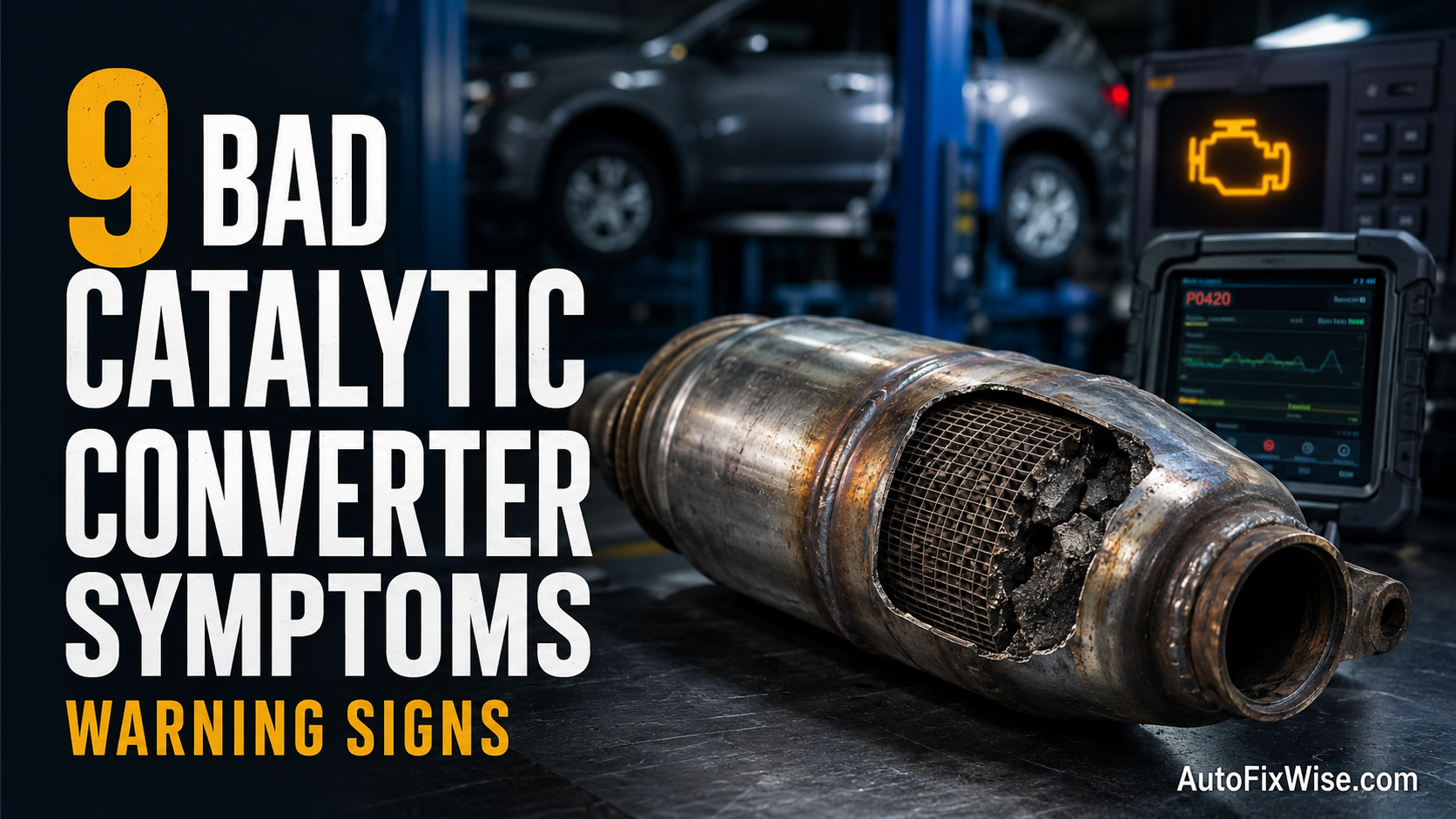
A failing catalytic converter does not always stop a vehicle from running. In many cases, the first warning is simply a check engine light. As the problem gets worse, you may notice weak acceleration, reduced fuel economy, unusual exhaust odors, rattling noises, or excessive heat beneath the vehicle.
Recognizing bad catalytic converter symptoms early can help you avoid a breakdown, failed emissions test, or damage to other exhaust components. However, these symptoms do not prove that the converter itself is defective. Ignition misfires, exhaust leaks, oxygen sensor faults, oil consumption, and fuel-mixture problems can produce similar warnings.
This guide explains nine common symptoms, what causes them, and how a technician can confirm whether the catalytic converter actually needs replacement.
Quick Answer: What Are the Most Common Bad Catalytic Converter Symptoms?
The most common symptoms of a failing or restricted catalytic converter include:
- An illuminated check engine light
- Sluggish acceleration or loss of power
- Reduced fuel economy
- A sulfur or rotten-egg smell
- Rattling noises beneath the vehicle
- Excessive heat from the exhaust system
- Dark exhaust smoke or increased emissions
- A failed emissions inspection
- Hard starting, rough running, or stalling
| Symptom | Possible Converter Problem | Urgency |
|---|---|---|
| Steady check engine light | Reduced catalyst efficiency | Schedule diagnosis soon |
| Flashing check engine light | Active misfire that may damage the converter | Stop driving when safe |
| Sluggish acceleration | Restricted exhaust flow | Inspect promptly |
| Rotten-egg odor | Improper fuel mixture or overheated catalyst | Diagnose promptly |
| Rattling underneath | Broken internal substrate | Inspect before further damage |
| Excessive floor or exhaust heat | Overheated or restricted converter | Stop if heat is severe |
| Failed emissions test | Converter not controlling emissions effectively | Repair before retesting |
| Hard starting or stalling | Severe exhaust restriction | Avoid continued driving |
1. The Check Engine Light Comes On
An illuminated check engine light is one of the most common bad catalytic converter symptoms.
The engine control module compares signals from oxygen sensors installed before and after the converter. The upstream sensor helps monitor the air-fuel mixture, while the downstream sensor helps the computer evaluate converter performance.
When the downstream signal begins to resemble the upstream signal too closely, the computer may determine that the converter is no longer storing oxygen and processing exhaust gases efficiently.
Common catalyst-related diagnostic trouble codes include:
- P0420: Catalyst System Efficiency Below Threshold, Bank 1
- P0430: Catalyst System Efficiency Below Threshold, Bank 2
A stored code does not automatically mean the converter should be replaced. Exhaust leaks, damaged wiring, sensor problems, engine misfires, or an incorrect air-fuel mixture may affect the readings.
If your scanner displays P0420, read our complete P0420 code diagnosis guide before purchasing parts.
A flashing check engine light is more urgent
A steady check engine light generally means the vehicle should be inspected soon. A flashing check engine light often indicates an active misfire.
A severe misfire can send unburned fuel into the exhaust. That fuel may ignite inside the converter, causing extreme heat that melts or damages its internal structure.
If the light flashes while the engine runs roughly or loses power, reduce speed, pull over safely, and arrange professional assistance.
2. Sluggish Acceleration or Loss of Power
A partially blocked converter can restrict exhaust flow. The engine may struggle to expel exhaust gases, making it difficult to draw in a fresh air-fuel charge.
The vehicle may feel normal at idle but weak during:
- Highway merging
- Hill climbing
- Heavy acceleration
- Towing
- Driving at higher engine speeds
Some drivers describe the sensation as if the engine is “choking” or the vehicle is carrying extra weight.
Power loss can also be caused by a clogged air filter, weak fuel pump, ignition problem, transmission fault, turbocharger issue, or another exhaust restriction. A technician should test the system instead of assuming the converter is responsible.
Possible diagnostic methods include measuring exhaust backpressure, comparing exhaust temperatures, reviewing fuel-trim data, and inspecting oxygen-sensor activity.
3. Reduced Fuel Economy
A restricted or inefficient converter may contribute to lower fuel economy, although it is rarely the only possible cause.
When exhaust flow is restricted, the engine must work harder to produce the requested power. Drivers may press the accelerator farther than usual, increasing fuel consumption.
Fuel economy can also decrease because of:
- A rich air-fuel mixture
- Faulty oxygen or mass airflow sensors
- Ignition misfires
- Low tire pressure
- Dragging brakes
- Short-trip driving
- Cold weather
- Poor-quality fuel
- Delayed maintenance
Compare fuel economy over several complete tanks rather than relying only on the dashboard display. If consumption rises suddenly along with a warning light, odor, or performance problem, have the vehicle scanned.
Do not replace the converter based solely on reduced gas mileage.
4. A Sulfur or Rotten-Egg Smell
A strong sulfur-like odor from the exhaust is often described as smelling like rotten eggs.
This odor may appear when the engine runs too rich, meaning it receives more fuel than it can burn correctly. Excess fuel and sulfur compounds can overload the converter and create an unpleasant smell.
Possible causes include:
- Leaking fuel injectors
- Incorrect fuel pressure
- Faulty oxygen sensors
- Ignition misfires
- Airflow-sensor problems
- Contaminated fuel
- An overheated or failing converter
The odor alone does not confirm converter failure. In fact, the engine problem causing the smell may be what eventually damages the converter.
A technician should diagnose and correct the fuel or ignition problem before installing a replacement.
5. Rattling Noises Under the Vehicle
A catalytic converter contains a ceramic or metallic substrate with thousands of small passages. This internal structure can crack or break apart after impact, overheating, contamination, or repeated thermal stress.
Loose pieces may produce a metallic rattle, especially when:
- Starting the engine
- Idling
- Changing engine speed
- Driving over bumps
- Shutting the engine off
A loose heat shield can produce a similar sound and may be much less expensive to repair. Exhaust clamps, brackets, hangers, and internal muffler components can also rattle.
The sound should be inspected before ordering a converter. If the internal substrate has broken apart, pieces may shift and partially block the exhaust outlet, causing intermittent power loss.
6. Excessive Heat Beneath the Vehicle
Catalytic converters normally operate at high temperatures. Excessive heat, however, can indicate that the converter is overloaded or that unburned fuel is entering the exhaust.
Warning signs include:
- Unusual heat through the floor
- A burning smell
- Discolored converter housing
- Melted nearby wiring or insulation
- Smoke from beneath the vehicle
- A converter that appears to glow after driving
Do not touch an exhaust component to check its temperature. The converter and surrounding pipes can cause severe burns long after the engine has been switched off.
Extreme heat can result from an active misfire, rich fuel mixture, exhaust restriction, or internal converter damage. Continuing to drive may harm oxygen sensors, wiring, exhaust valves, and nearby underbody components.
If you notice smoke, a glowing converter, severe burning smells, or a flashing check engine light, stop driving when it is safe. Do not park over dry grass, leaves, or other combustible material.
7. Dark Exhaust Smoke or Increased Emissions
A damaged converter may no longer process pollutants effectively. The exhaust can contain increased levels of hydrocarbons, carbon monoxide, or nitrogen oxides even when the vehicle seems to run normally.
Dark smoke, however, usually points to an engine problem rather than the converter alone:
- Black smoke may indicate excessive fuel.
- Blue-gray smoke may indicate oil burning.
- Persistent thick white smoke may indicate coolant entering the engine.
Oil, coolant, and excess fuel can contaminate or overheat a catalytic converter. Replacing the converter without repairing the source of the smoke can quickly damage the new part.
A tailpipe emissions test or gas analyzer can help determine whether the engine is burning correctly and whether the converter is treating the exhaust effectively.
8. The Vehicle Fails an Emissions Inspection
A failed emissions inspection may be the first noticeable sign of reduced converter efficiency.
Depending on the state and inspection program, failure may result from:
- Stored emissions-related trouble codes
- An illuminated check engine light
- Incomplete readiness monitors
- Excessive tailpipe emissions
- Missing or modified emissions equipment
- An incorrect aftermarket converter
- Visible exhaust-system damage
Clearing the codes shortly before an inspection usually resets the readiness monitors. The vehicle may then be rejected because its self-tests have not been completed.
Replacing the converter is not always the correct first step. The vehicle may fail because of an oxygen sensor, exhaust leak, misfire, evaporative-emissions fault, or another engine-control issue.
Scan the vehicle, record all codes, and confirm that its readiness monitors have completed before returning for a retest.
9. Hard Starting, Rough Running, or Stalling
A severely restricted converter can create enough exhaust backpressure to interfere with engine operation.
Possible symptoms include:
- Extended cranking
- Rough idle
- Stalling after starting
- Engine speed that will not increase normally
- Power that drops as the engine warms up
- An engine that starts again after cooling down
These symptoms require prompt diagnosis because many other faults can cause them. Fuel-delivery problems, ignition faults, vacuum leaks, timing problems, electrical failures, and security-system issues can all produce hard starting or stalling.
If exhaust restriction is suspected, a technician may perform a backpressure test or temporarily test pressure through an oxygen-sensor port. Professional testing is safer and more reliable than replacing parts based on symptoms alone.
What Causes a Catalytic Converter to Fail?
Catalytic converters generally do not fail without a reason. Age and physical damage can affect them, but engine-related problems are frequent causes.
Ignition misfires
Worn spark plugs, defective ignition coils, injector problems, or low compression may cause a cylinder to misfire. Unburned fuel can then enter the converter and create damaging heat.
Rich air-fuel mixture
A leaking injector, excessive fuel pressure, airflow-sensor fault, or oxygen-sensor problem may cause the engine to use too much fuel.
Oil consumption
Worn piston rings, valve seals, turbocharger seals, or problems with the crankcase ventilation system can allow engine oil to enter the combustion chamber. Oil residue may coat the converter’s active surfaces.
Coolant entering the engine
A damaged head gasket, cracked cylinder head, or intake-manifold problem can allow coolant into the combustion chamber and exhaust.
Exhaust leaks
A leak near an oxygen sensor can introduce outside air and distort sensor readings. This may cause misleading catalyst-efficiency codes.
Physical impact
Road debris, speed bumps, collisions, or improper lifting can dent the housing or crack its internal structure.
Incorrect replacement part
A converter that is too small, poorly manufactured, incorrectly installed, or not approved for the vehicle may cause repeat codes and inspection problems.
Bad Converter or Bad Oxygen Sensor?
A catalyst-efficiency code can lead drivers to suspect either the converter or an oxygen sensor. Symptoms alone usually cannot separate the two.
| Observation | Possible Converter Issue | Possible Sensor or Wiring Issue |
|---|---|---|
| P0420 or P0430 code | Yes | Possible |
| Poor acceleration | Possible restriction | Less commonly |
| Internal rattling | Likely physical converter damage | Unlikely |
| Heater or circuit code | Unlikely | More likely |
| Damaged sensor wiring | No | Likely |
| Failed catalyst monitor | Possible | Possible |
| Excessive backpressure | Likely restriction | Unlikely |
An oxygen sensor should not be replaced merely because a catalyst code is present. A scan tool can display upstream and downstream sensor patterns, but those readings must be interpreted together with fuel trims, exhaust leaks, operating temperature, and other test results.
The oxygen sensors help the computer manage the air-fuel mixture and monitor converter operation. An engine that runs incorrectly can damage both the converter and sensors.
How Is a Bad Catalytic Converter Diagnosed?
A careful diagnosis may include several steps.
1. Scan every control module
Record stored, pending, and permanent trouble codes before clearing anything. Misfire, fuel-trim, oxygen-sensor, and temperature codes may provide essential clues.
2. Check freeze-frame information
Freeze-frame data shows vehicle conditions when the code was stored, such as engine speed, coolant temperature, load, speed, and fuel trims.
3. Inspect for exhaust leaks
Leaks near the manifold, flex pipe, converter, or oxygen sensors can affect test results.
4. Correct engine problems first
Misfires, rich operation, oil burning, coolant loss, and fuel-control faults should be repaired before judging the converter.
5. Review live sensor data
A technician can compare upstream and downstream oxygen-sensor behavior after the engine and converter reach operating temperature.
6. Test exhaust restriction
Backpressure testing can help identify a melted, collapsed, or blocked substrate.
7. Inspect the converter physically
Dents, impact marks, discoloration, loose internal material, damaged flanges, and previous repairs may reveal the cause.
No single temperature reading or sensor pattern is conclusive for every vehicle. Manufacturer procedures and technical service information should be considered.
Can You Drive With a Bad Catalytic Converter?
A vehicle with a steady check engine light and no drivability symptoms may remain operable for a limited time, but delaying diagnosis can increase emissions and allow an underlying engine problem to worsen.
Stop driving and arrange assistance if you experience:
- A flashing check engine light
- Severe power loss
- Repeated stalling
- Smoke beneath the vehicle
- A glowing converter
- Strong burning odors
- Extreme heat through the floor
- Loud internal rattling followed by restricted performance
A badly restricted converter can eventually prevent the engine from running. An overheated converter can also damage nearby parts and create a fire risk.
How Much Does Replacement Cost?
Catalytic converter pricing varies widely. A typical complete repair may cost approximately $1,000 to $3,500, while luxury, hybrid, high-performance, and multi-converter vehicles can cost considerably more.
The total depends on:
- OEM or aftermarket part
- Federal or CARB certification
- Vehicle make, model, engine, and year
- Number and location of converters
- Local labor rates
- Rusted or broken exhaust hardware
- Required oxygen sensors or exhaust repairs
See our full catalytic converter replacement cost guide for detailed parts, labor, warranty, and emissions-compliance information.
Before paying for replacement, check whether the vehicle may still qualify for federal or manufacturer emissions-warranty coverage.
Can a Catalytic Converter Be Cleaned?
A chemical cleaner cannot repair a melted, cracked, broken, or oil-contaminated converter.
Some products claim to remove light deposits, but they cannot correct:
- A collapsed substrate
- Physical impact damage
- Severe overheating
- Missing catalyst material
- Persistent oil or coolant contamination
- An active engine-control problem
Using an additive may delay proper diagnosis. If the converter code was caused by a misfire, rich mixture, exhaust leak, or sensor fault, the actual problem will remain.
Diagnose the engine and exhaust system before attempting any treatment.
Frequently Asked Questions
What does a bad catalytic converter sound like?
A physically damaged converter may make a metallic rattling sound because its internal substrate has cracked or broken loose. Heat shields, brackets, and mufflers can create similar noises, so the exhaust should be inspected.
Will a bad catalytic converter always trigger a code?
No. A restricted or physically damaged converter may cause performance symptoms before the computer stores an efficiency code. Some early vehicles also have less sophisticated catalyst monitoring.
Can a bad oxygen sensor damage the converter?
A sensor fault that causes the engine to run excessively rich may contribute to converter overheating or contamination. However, not every oxygen-sensor failure changes the fuel mixture in the same way.
Can bad spark plugs damage a catalytic converter?
Yes. Worn or fouled spark plugs may cause misfires. Unburned fuel entering the exhaust can overheat and damage the converter.
How long does a catalytic converter normally last?
Many original converters last more than 100,000 miles when the engine is properly maintained. Misfires, oil burning, coolant leaks, impact damage, and incorrect fuel control can shorten their service life.
Does a rotten-egg smell always mean the converter is bad?
No. The odor may result from an overly rich fuel mixture, poor combustion, fuel quality, or converter overload. Diagnose the engine before replacing the converter.
Will removing the converter solve the problem?
No. Removing or disabling required emissions equipment on a street-driven vehicle violates federal law in the United States. It can also create warning lights, inspection failure, excessive emissions, noise, and drivability problems.
Can a bad converter cause a P0420 code?
Yes. Reduced converter efficiency is a common cause of P0420, but exhaust leaks, oxygen-sensor issues, wiring problems, and incorrect engine operation should be ruled out first.
The Bottom Line
The most recognizable bad catalytic converter symptoms include a check engine light, weak acceleration, poor fuel economy, sulfur odors, rattling, excessive heat, increased emissions, inspection failure, and severe starting or stalling problems.
None of these symptoms should be treated as proof on its own. A converter is expensive, and replacing it without correcting an engine misfire, rich mixture, oil-burning problem, coolant leak, or exhaust leak can lead to another failure.
Have the complete engine and exhaust system tested before authorizing replacement. A careful diagnosis protects both your vehicle and your repair budget.
2 thoughts on “9 Bad Catalytic Converter Symptoms You Shouldn’t Ignore”