
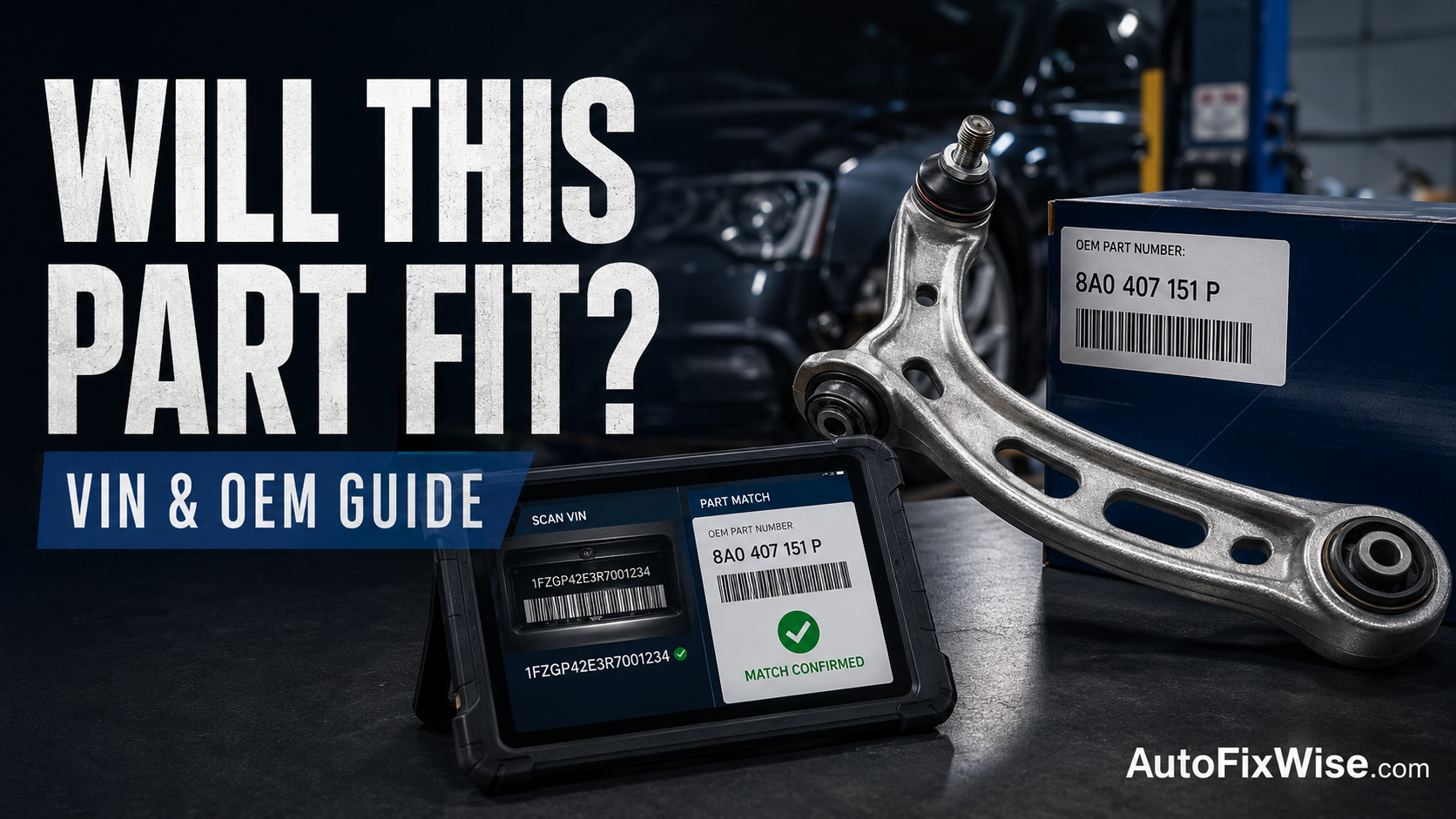
Ordering the wrong car part can waste time, create return costs, and leave a vehicle unusable while you wait for a replacement. A listing that says a part fits your make, model, and year is a useful starting point, but it is not always enough to confirm compatibility.
The most reliable way to check if a car part fits your vehicle is to compare the VIN, original equipment manufacturer part number, engine, production date, drivetrain, body style, and vehicle-specific options. Depending on the component, you may also need measurements, connector photographs, emissions specifications, or brake and suspension codes.
This guide explains how to perform a practical fitment check before ordering OEM, aftermarket, remanufactured, or used automotive parts.
Quick Answer: How Do You Check Whether a Car Part Fits?
Use the following order:
- Record the complete vehicle identification number.
- Decode the VIN and verify the basic vehicle information.
- Identify the original part number whenever possible.
- Check whether the number has been replaced or superseded.
- Match the engine, transmission, drivetrain, body style, and production date.
- Compare connectors, mounting points, dimensions, and specifications.
- Confirm the result through a manufacturer catalog or knowledgeable parts supplier.
- Review the seller’s fitment notes and return policy before ordering.
| Information | Why It Matters |
|---|---|
| VIN | Identifies the specific vehicle and basic factory configuration |
| OEM part number | Identifies the original component or part family |
| Model year | Helps narrow the correct application |
| Production date | Separates mid-year design changes |
| Engine code | Distinguishes engines with different systems and components |
| Transmission | Affects mounts, sensors, cooling parts, axles, and more |
| FWD, RWD, AWD, or 4WD | Changes many suspension and drivetrain parts |
| Body style | Sedan, hatchback, coupe, wagon, and SUV parts may differ |
| Trim and options | Brake, lighting, suspension, and electrical equipment may vary |
| Emissions specification | Determines sensors, exhaust parts, and catalytic converters |
What Is a VIN?
A VIN, or vehicle identification number, is a unique identifier assigned to a vehicle.
Most road vehicles manufactured for the United States since the 1981 model year use a standardized 17-character VIN. Older vehicles and vehicles produced for other markets may use a different format.
A VIN can help identify information such as:
- Manufacturer
- Model year
- Vehicle type
- Body class
- Engine information
- Manufacturing plant
- Production sequence
- Country of manufacture
The exact information encoded in a VIN varies by manufacturer. A VIN decoder may not display every option installed on the vehicle, so it should not be treated as a complete parts catalog.
Where can you find the VIN?
Common locations include:
- Driver-side dashboard near the windshield
- Driver-side door jamb
- Vehicle registration
- Insurance documents
- Title documents
- Manufacturer identification label
- Vehicle service records
Check the characters carefully. The letters I, O, and Q are generally excluded from standardized VINs to reduce confusion with the numbers 1 and 0.
For basic vehicle identification, use the official NHTSA VIN Decoder.
Can a VIN Guarantee That a Part Will Fit?
Not by itself.
The VIN identifies the vehicle, but correct parts selection requires a catalog that connects the VIN or factory build information to a specific component.
A general VIN decoder may identify a 2.0-liter engine but not reveal every detail needed to select:
- Brake rotor diameter
- Alternator output
- Suspension package
- Headlight technology
- Emissions calibration
- Axle ratio
- Tow package
- Cooling package
- Connector version
- Production revision
A professional OEM catalog may provide more detailed build and option information than a public decoder. Even then, modifications made after the vehicle left the factory can change what is currently installed.
Treat the VIN as the beginning of the fitment process, not the only test.
What Is an OEM Part Number?
An OEM part number is the identification number assigned to a component by the vehicle manufacturer or its original equipment system.
It may appear on:
- A printed label
- An engraved surface
- A casting
- A metal plate
- Original packaging
- A dealer invoice
- An electronic parts catalog
Searching by OEM number is often more accurate than searching only by vehicle year and model.
For example, two vehicles with the same model name and year may use different radiators because one has an automatic transmission and the other has a manual transmission. Their original part numbers can reveal that difference.
How to Find the Original Part Number
The original number may be visible after cleaning the component carefully.
Look for:
- Manufacturer logo
- Long alphanumeric number
- Barcode label
- Engineering number
- Supplier number
- Date code
- Revision letter
- Left- or right-side marking
Photograph the complete label before removing or cleaning it aggressively. Some printed labels fade easily.
Part number or casting number?
A number molded into a housing is not always the orderable part number.
The same housing may be used in several finished assemblies with different:
- Sensors
- Connectors
- Internal components
- Software
- Brackets
- Gear ratios
- Calibration
- Side-specific equipment
Use a casting number as supporting information. Do not assume it identifies the complete service part unless the manufacturer catalog confirms it.
What Is a Superseded Part Number?
Manufacturers may replace an older part number with a newer one. This is called a supersession.
A number may change because of:
- Design improvements
- Supplier changes
- Updated materials
- Revised packaging
- Consolidated applications
- Regulatory changes
- A new mounting kit
- Software or calibration updates
An old and new number may both be correct if the catalog shows a direct supersession.
However, similar-looking numbers are not automatically interchangeable. A changed suffix can indicate a minor revision—or a completely different application.
Confirm whether the supersession is:
- Direct
- One-way only
- Conditional
- Dependent on additional parts
- Limited by production date
- Restricted by VIN range
Some updated parts require a new bracket, wiring adapter, gasket, fastener, software update, or matching component.
Step-by-Step Car Part Compatibility Check
1. Record the Vehicle Information
Before searching for the part, collect:
- Complete VIN
- Year
- Make
- Model
- Trim or submodel
- Engine size and code
- Fuel type
- Transmission
- Drivetrain
- Body style
- Production date
- Registration market or country
Do not rely entirely on the year shown on registration documents. A vehicle registered as one year may have been manufactured during the previous year.
2. Identify the Exact Part
Use the original component, dealer catalog, repair invoice, or manufacturer diagram to determine its correct name and location.
Terms used by owners and sellers may differ. For example:
- Splash shield vs. underbody cover
- Radiator support vs. front carrier
- Clock spring vs. spiral cable
- Control arm vs. wishbone
- Coolant flange vs. water outlet
- Wheel-speed sensor vs. ABS sensor
A correct part name prevents searches from returning a related but different component.
3. Locate the OEM Number
Record every visible character, including spaces, dashes, and suffix letters.
If the number is unclear:
- Photograph it from several angles.
- Use better lighting.
- Clean only the label area gently.
- Compare it with a catalog diagram.
- Ask a dealer or parts specialist to check the VIN.
Do not guess a missing digit. One incorrect character may lead to a different part.
4. Check for Supersessions
Search the original number in a reliable OEM catalog and determine whether it has been replaced.
Confirm any notes such as:
- Up to a specific production date
- From a specific VIN
- For vehicles with sport suspension
- For automatic transmission
- Without adaptive headlights
- For federal emissions only
- Requires additional mounting kit
The notes can be more important than the headline compatibility list.
5. Match the Vehicle Configuration
Compare the listing against the actual vehicle.
Important configuration details include:
- Engine displacement
- Engine code
- Number of cylinders
- Turbocharged or naturally aspirated
- Gasoline, diesel, hybrid, or electric
- Manual, automatic, CVT, or dual-clutch transmission
- Front-, rear-, all-, or four-wheel drive
- Standard or heavy-duty suspension
- Wheel and brake package
- Left- or right-hand drive
- Federal or California emissions
- Factory tow package
A listing that matches the year, make, and model but specifies a different engine or drivetrain should not be assumed compatible.
6. Compare the Physical Part
When possible, compare the new and old components side by side before installation.
Check:
- Overall dimensions
- Mounting-hole locations
- Connector shape
- Number of electrical pins
- Hose diameter
- Pipe angle
- Thread size
- Sensor locations
- Bracket position
- Left- or right-side orientation
- Pulley or gear count
- Included hardware
A photograph is useful, but it should not replace catalog confirmation. Product images may be generic or may show a different production batch.
7. Confirm With the Seller
Before ordering, send the seller:
- VIN
- OEM number
- Vehicle details
- Photograph of the original part
- Connector photograph
- Production date
- Any relevant measurements
Ask for written confirmation that the item fits the exact vehicle.
A useful message is:
Please confirm compatibility with VIN [VIN], engine [engine code], production date [date], and original part number [OEM number]. The attached photographs show the original component and connector.
Keep the seller’s response with the order records.
8. Check the Return and Warranty Terms
Even careful catalogs can contain errors, and vehicles may have undocumented modifications.
Before installation, confirm:
- Return period
- Restocking fee
- Warranty coverage
- Core-return requirement
- Electrical-parts policy
- Whether installation prevents return
- Who pays return shipping
- Whether professional installation is required
Do not discard the packaging until the part has been verified.
Why Year, Make, and Model Are Not Enough
Manufacturers frequently make running production changes.
A vehicle may use one component before a certain date and another afterward, even though both vehicles share the same advertised model year.
Differences may also result from:
- Multiple factories
- Different suppliers
- Regional specifications
- Optional equipment
- Facelift changes
- Heavy-duty packages
- Emissions regulations
- Engine or transmission revisions
- Parts shortages during production
That is why listings sometimes include terms such as:
- “To 03/2020”
- “From VIN ending 123456”
- “Without sport package”
- “For 320 mm brakes”
- “Federal emissions”
- “With LED headlights”
Read every fitment note before purchasing.
Parts That Require Extra Fitment Checks
Some components are more difficult to identify than others.
Brake Parts
Brake pads, rotors, calipers, and shields may vary according to:
- Rotor diameter
- Caliper manufacturer
- Performance package
- Wheel size
- Axle load
- Electronic parking brake
- Production date
Measure the rotor and identify the caliper when the catalog offers multiple choices.
Lighting Components
Headlights and taillights may differ by:
- Halogen, HID, or LED technology
- Adaptive lighting
- Daytime running light design
- Connector type
- Left- or right-hand traffic
- Facelift version
- Control module
- Trim level
A housing may physically bolt into place but still require different wiring, programming, or control modules.
Cooling-System Parts
Radiators, fans, condensers, and hoses may depend on:
- Engine
- Transmission
- Air conditioning
- Tow package
- Climate package
- Cooling capacity
- Sensor layout
- Hose connections
Compare core dimensions, pipe locations, and transmission-cooler connections.
Sensors and Electronic Modules
Electronic parts may require matching:
- Connector
- Pin count
- Frequency
- Software version
- Hardware revision
- Calibration
- Security coding
- Communication protocol
Some control modules must be programmed or adapted after installation. A physically identical used module may not operate correctly without coding.
Exhaust and Emissions Parts
Catalytic converters, oxygen sensors, exhaust manifolds, and related components may vary by engine family and emissions certification.
Verify whether the vehicle uses:
- Federal emissions
- California emissions
- A specific engine family
- Bank 1 or Bank 2 components
- Upstream or downstream sensors
- A direct-fit or universal converter
An incorrect converter can create installation problems, emissions-test failure, or repeat catalyst-efficiency codes. Our P0420 code guide explains why proper diagnosis and converter selection matter.
Suspension and Drivetrain Parts
Control arms, axles, wheel bearings, springs, shocks, mounts, and driveshafts may vary by:
- Drivetrain
- Ride height
- Sport suspension
- Electronic damping
- Axle rating
- Transmission
- Differential
- Wheel hub
- Body style
Never assume FWD and AWD versions use the same axle or suspension component.
OEM vs. Aftermarket Fitment
An aftermarket part may fit correctly even when its number differs from the manufacturer’s number. The aftermarket brand normally provides a cross-reference linking its product to one or more OEM numbers.
Before ordering, verify:
- Cross-referenced OEM numbers
- Vehicle application
- Dimensions
- Connector
- Material
- Certification
- Included hardware
- Warranty
A large compatibility list does not necessarily mean the part is correct for every version of every listed vehicle.
Quality aftermarket manufacturers often publish detailed application notes. Read those notes instead of relying only on a marketplace’s “fits your vehicle” banner.
Can the Same Part Fit Different Vehicles?
Yes. Manufacturers sometimes share platforms, engines, transmissions, sensors, and other components across several models or brands.
The same component may appear on vehicles with different:
- Brand names
- Model names
- Body styles
- Production countries
However, visual similarity is not enough to establish interchangeability.
Shared parts may still differ in:
- Mounting brackets
- Software
- Connector orientation
- Pipe length
- Calibration
- Finish
- Side
- Emissions approval
Use confirmed cross-reference data rather than assuming vehicles on the same platform use every part interchangeably.
New, Used, and Remanufactured Part Checks
New parts
Confirm the catalog application, part number, specifications, and included hardware.
Used parts
Also compare:
- Donor vehicle VIN
- Donor production date
- Mileage
- Damage
- Corrosion
- Connector condition
- Programming requirements
- Revision number
Remanufactured parts
Check:
- Core-return requirements
- Manufacturer warranty
- Calibration
- Included seals or accessories
- Approved applications
- Installation instructions
A remanufactured assembly may require returning the original unit in rebuildable condition.
Common Fitment Mistakes
Avoid these common errors:
- Shopping by appearance alone
- Ignoring the engine code
- Confusing model year with production date
- Assuming all trim levels use the same part
- Ignoring left- and right-side designations
- Ordering by a casting number
- Missing a superseded part number
- Trusting a generic product photograph
- Ignoring emissions specifications
- Failing to compare connectors
- Discarding packaging before verification
- Installing the part before checking the return policy
Taking a few minutes to collect complete vehicle information is usually faster than returning an incorrect component.
What to Do When Two Different Parts Are Listed
If a catalog shows two possible parts for the same vehicle:
- Read every fitment note.
- Check the production date.
- Confirm the engine and drivetrain.
- Compare the original part number.
- Inspect the connector and mounting points.
- Measure the original component.
- Contact a dealer or experienced supplier with the VIN.
Do not choose based only on price.
The more expensive option is not automatically correct, and the cheaper option is not necessarily lower quality. The application details determine which one fits.
Frequently Asked Questions
Does matching the OEM number guarantee fitment?
A confirmed matching service number is a strong indicator, but check supersessions, suffixes, production notes, and required additional parts. Also verify that the vehicle has not been modified.
Can I find every part number using the VIN?
Not with a general VIN decoder. A manufacturer or dealer catalog may use the VIN to access more detailed factory information, but some parts still require physical inspection or option-code verification.
Is the number stamped on the part always the OEM number?
No. It may be a casting, engineering, supplier, batch, or production number rather than the orderable service number.
Can two different OEM numbers fit the same vehicle?
Yes. One number may supersede another, or several approved versions may exist. Confirm the relationship through a reliable catalog.
Why does a website say a part fits when the connector is different?
The listing may be incorrect, the vehicle may have a mid-year production change, or the catalog may require an additional fitment selection. Compare the original component before installation.
Does the VIN show the engine code?
A VIN decoder may display engine type or displacement, but it may not show the manufacturer’s complete engine code. Check the vehicle label, engine marking, service records, or manufacturer catalog.
Can I use a part from another model?
Only when an authoritative catalog or interchange system confirms compatibility. Similar appearance or a shared vehicle platform is not sufficient evidence.
Should I share my VIN with a parts seller?
A VIN is commonly used for vehicle identification and parts lookup. Share it with a reputable dealer or supplier when needed, but avoid publishing unnecessary vehicle information in untrusted public listings.
Should I install the part if it looks slightly different?
Pause the installation. A revised part may look different and still be correct, but the change should be supported by a catalog supersession or manufacturer instruction.
Final Fitment Checklist
Before purchasing, confirm:
- VIN has been entered correctly
- Year, make, and model match
- Production date matches
- Engine and transmission match
- Drivetrain matches
- Body style and trim match
- OEM number or confirmed supersession matches
- Left or right side is correct
- Dimensions and mounting points match
- Electrical connector and pin count match
- Emissions specification matches
- Additional hardware is identified
- Seller has confirmed fitment
- Return and warranty policies are understood
The Bottom Line
To check if a car part fits your vehicle, do not rely on year, make, and model alone.
Begin with the VIN, then confirm the original part number, supersessions, engine, production date, transmission, drivetrain, body style, and factory options. Compare the physical component and read every catalog note before installation.
The most reliable fitment decision combines vehicle data, manufacturer catalog information, and physical verification. This process takes slightly longer before ordering, but it can prevent incorrect purchases, repeat labor, vehicle downtime, and unnecessary return costs.