
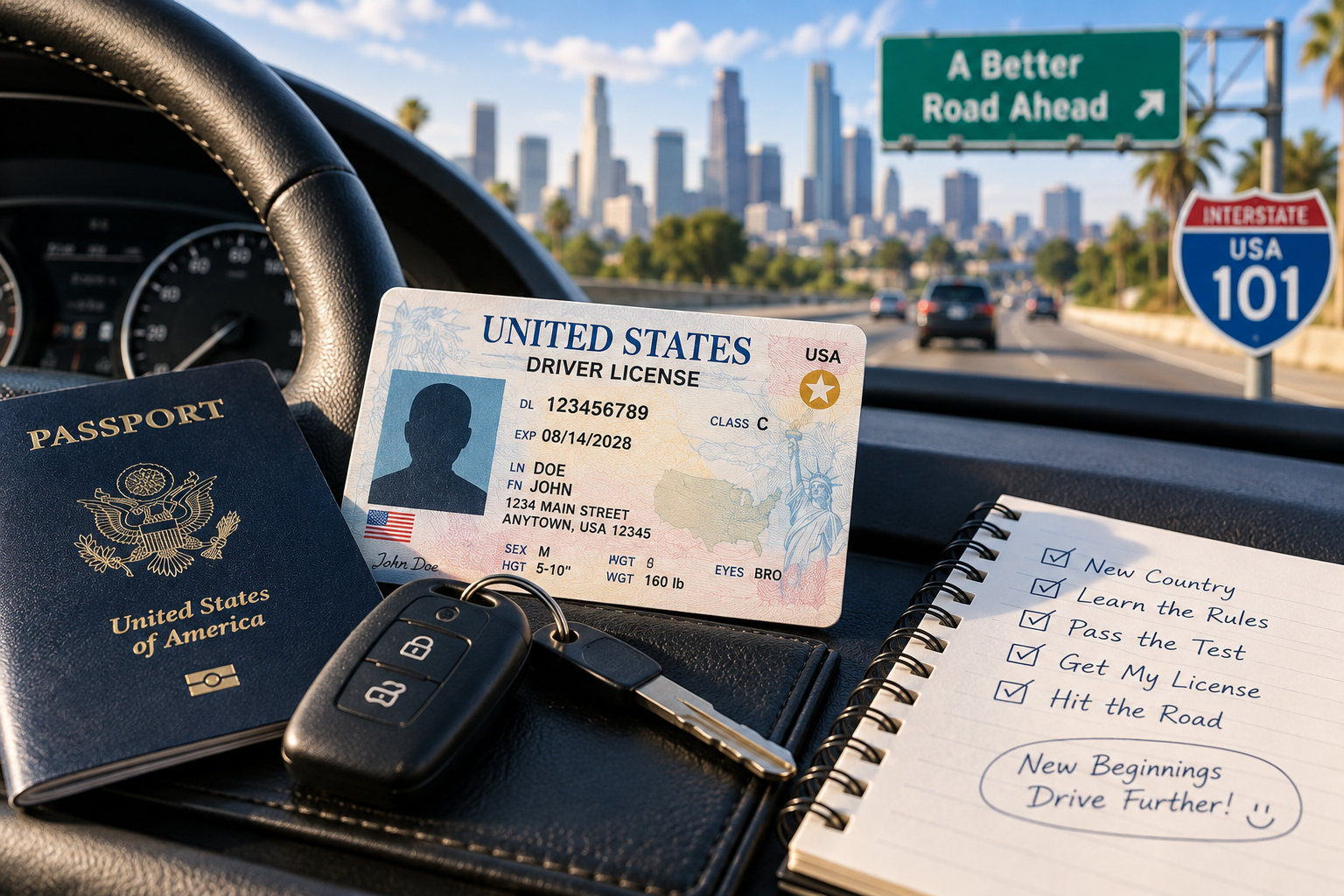
Moving to the United States comes with a long list of things to figure out. Finding a place to live, getting a phone plan, opening a bank account, and, for many people, getting a driver’s license.
If you’re coming from another country, the driver’s license process can be a little confusing at first. One of the biggest reasons is that there isn’t one single driver’s license system for the entire country. Each state has its own Department of Motor Vehicles (DMV) or similar agency, and the rules aren’t exactly the same everywhere.
The good news is that you don’t have to be a U.S. citizen to get a driver’s license.
If you’re living in the U.S. legally and meet your state’s requirements, you may be able to get a state driver’s license even if you’re not an American citizen.
Here’s what the process usually looks like and what you should know before heading to the DMV.
Can a Foreigner Get a Driver’s License in the USA?
Yes.
U.S. citizenship is generally not required to get a driver’s license. What matters is whether you meet the requirements of the state where you live.
This is where things can get confusing.
The requirements for someone living in California may be different from those for someone living in Texas, Florida, New York, or another state.
Your immigration status, age, whether you already have a foreign driver’s license, and whether you have a Social Security number can all affect the process.
In many cases, you may need documents such as:
- A valid passport
- Visa or immigration documents
- Proof of lawful status or authorized stay
- Social Security number, if applicable
- Proof that you live in the state
- Your existing foreign driver’s license, if you have one
Don’t assume that having a passport is enough. This is one of those situations where checking your state’s DMV requirements before you go can save you a lot of time.
Do You Need to Be a U.S. Citizen?
No.
This is a common question from people who have recently moved to the United States.
Non-U.S. citizens can obtain driver’s licenses in many states. The DMV will usually ask for documents that establish your identity and your legal presence in the country.
The exact requirements depend on your situation.
For example, someone with a Green Card may have different documentation requirements than someone in the U.S. temporarily on a visa.
Some states also issue licenses with a limited validity period when the applicant’s authorized stay in the U.S. is temporary.
So if you’re not a U.S. citizen, don’t be surprised if the DMV asks for immigration documents in addition to your passport.
The First Thing You Should Do: Check Your State’s DMV
Before worrying about the driving test or studying for the written exam, figure out which agency handles driver’s licenses in your state.
Most people simply refer to it as the DMV, although the agency has a different name in some states.
This is important because there is no single set of rules for getting a driver’s license in America.
For example, the documents accepted in Texas aren’t necessarily the same as those accepted in New York. The amount of driving practice required can also vary.
It’s a good idea to go directly to your state’s official driver’s licensing website and look at the requirements for your particular situation.
Don’t rely entirely on a friend who got their license in another state. Their experience may have been completely different from yours.
What Documents Do You Usually Need?
This depends on your state, but most applicants should expect to provide several documents.
Proof of Identity
Your passport is commonly used to establish your identity.
Depending on your situation, other documents such as a Permanent Resident Card or Employment Authorization Document may also be accepted.
Immigration Documents
If you’re not a U.S. citizen, the DMV may need to verify your immigration status or authorized stay.
Depending on your circumstances, this could include:
- Visa
- I-94 record
- Green Card
- Employment Authorization Document
- Other immigration documents
Bring the original documents or whatever specific forms your DMV says it accepts. A photocopy or an expired document may not be enough.
Social Security Number
Some states require a Social Security number when you apply for a driver’s license.
If you have one, you may need to provide documentation showing your SSN.
If you don’t have a Social Security number because you’re not eligible for one, don’t automatically assume that you can’t get a license. Some states have other procedures for applicants in this situation.
The important part is checking your state’s rules.
Proof of Address
You’ll usually need to show that you actually live in the state where you’re applying.
Depending on the state, documents may include things like:
- Lease agreement
- Utility bill
- Bank statement
- Insurance document
- Pay stub
- Government mail
Some states require more than one proof of residency, so check the list before making your appointment.
Can You Use Your Foreign Driver’s License?
Possibly.
If you already have a valid driver’s license from your home country, you may be able to use it for some period of time after arriving in the United States.
However, a foreign driver’s license doesn’t automatically transfer to a U.S. driver’s license.
This is one of the biggest things newcomers misunderstand.
Some states have agreements with certain countries that can make the process easier. In other states, you’ll still have to take the written test, road test, or both.
Your situation can also change once you become a resident of the state.
So if you’re moving to the U.S. rather than just visiting, don’t assume you can keep driving forever with your home country’s license.
Do You Have to Take a Written Test?
If you’re applying for a driver’s license for the first time, there’s a good chance you’ll have to take a knowledge test.
The test is usually based on your state’s driver’s handbook.
You’ll typically see questions about:
- Traffic signs
- Right-of-way
- Speed limits
- Lane markings
- Parking
- Traffic lights
- Safe driving
- Alcohol and drug laws
- Pedestrian rules
The good news is that most states provide a driver’s handbook online for free.
I’d strongly recommend reading the handbook rather than relying only on random practice questions online. State traffic laws can be surprisingly different from what you’re used to in your home country.
Do You Have to Take a Driving Test?
In many cases, yes.
If you’re getting your first U.S. driver’s license, you’ll generally need to demonstrate that you can safely operate a vehicle.
The examiner may ask you to demonstrate things such as:
- Turning correctly
- Changing lanes
- Stopping at intersections
- Using turn signals
- Checking mirrors
- Following traffic signs
- Backing up
- Parking
- Maintaining control of the vehicle
The exact test depends on your state.
If you’ve been driving for years in another country, the actual driving may not be the difficult part. The bigger challenge can sometimes be remembering the small rules that the examiner expects you to follow.
That’s another reason to read the state driver’s handbook before the test.
What If You Don’t Have a Social Security Number?
This depends on your state and your immigration situation.
Not having an SSN doesn’t necessarily mean you cannot get a driver’s license.
Some states have procedures for people who are not eligible for a Social Security number, while others have different requirements.
Before making an appointment, check the official DMV website and look specifically for information about applicants without an SSN.
It’s much better to find out what documents you need beforehand than to arrive at the DMV and discover that you’re missing something.
Can Undocumented Immigrants Get a Driver’s License?
This is one of the questions where you really need to look at state law.
Some states allow people who don’t have lawful immigration status to obtain a driver’s license or another type of driving credential if they meet certain requirements.
Other states do not.
The rules can also change, so information you find online from a few years ago may no longer be accurate.
If this applies to you, check the current requirements directly with the driver’s licensing agency in your state.
What Is a REAL ID?
If you’ve started researching U.S. driver’s licenses, you’ve probably seen the term REAL ID.
A REAL ID is a state-issued driver’s license or identification card that meets federal security standards.
It’s still a driver’s license, but it has additional federal identification requirements.
You’ll generally need documents proving your identity, Social Security number, and state residency, although the exact requirements depend on your state.
If you’re getting a new license, it’s worth checking whether you want a REAL ID-compliant license.
This can be especially relevant if you plan to use your driver’s license for certain federal identification purposes, including domestic air travel.
How Much Does a Driver’s License Cost?
There isn’t one standard price across the United States.
The cost depends on your state and sometimes your age or the type of license you’re applying for.
You may have to pay fees for:
- Learner’s permit
- Knowledge test
- Road test
- Driver’s license
- Driver education
- Retesting
Some states bundle certain fees together, while others charge separately.
Check the current fee schedule on your state’s official DMV website before you apply.
How Long Does It Take to Get a Driver’s License?
For someone who already knows how to drive and has a valid foreign license, the process can sometimes be fairly straightforward.
For a first-time driver, it can take longer.
You may have to:
- Apply for a learner’s permit
- Pass a knowledge test
- Complete a required amount of supervised driving
- Pass a road test
- Pay the licensing fee
- Wait for the physical license to arrive
Your immigration documents can also affect processing time if the state needs to verify your status.
Because every state handles this differently, there isn’t a reliable nationwide answer such as “it takes two weeks.”
Can You Get a Driver’s License With a Tourist Visa?
This is another situation where you shouldn’t assume the rules are the same everywhere.
A tourist visiting the United States generally doesn’t go through the same process as someone who has moved to the country and established residency.
Whether a person with a particular immigration status can obtain a state driver’s license depends on state law and the documents they can provide.
If you’re in the U.S. temporarily, you may be able to drive using your valid foreign driver’s license under the state’s visitor rules instead of applying for a local license.
If you’re planning to stay longer or establish residency, check the rules for the state where you’ll be living.
Do You Need an International Driving Permit?
An International Driving Permit, or IDP, is not a replacement for your foreign driver’s license.
Think of it more as a standardized translation of your license information.
If you’re visiting the United States, an IDP can be useful, particularly if your original license isn’t written in English. Rental car companies may also have their own requirements.
But an IDP doesn’t give you a U.S. driver’s license.
If you become a resident of a state and that state requires you to obtain a local license, an IDP won’t replace that requirement.
What Happens If You Fail the Driving Test?
Don’t panic.
Failing a road test doesn’t mean you can’t get a driver’s license. In most states, you can take the test again after following the required waiting period.
You may have to pay another testing fee.
The best thing you can do after failing is find out exactly what went wrong.
Was it a problem with lane changes? Parking? Turning? Not checking your mirrors?
Fix those specific issues before taking the test again.
A Simple Checklist Before Going to the DMV
If you’re getting ready to apply, here’s a useful checklist:
☐ Check your state’s DMV requirements
☐ Make sure your passport and immigration documents are valid
☐ Check whether you need an SSN
☐ Gather proof of residency
☐ Find out whether your foreign license is accepted
☐ Study your state’s driver’s handbook
☐ Find out whether you need a learner’s permit
☐ Check testing requirements
☐ Check the current fees
☐ Make an appointment if your state requires one
It sounds simple, but missing one document can turn a quick DMV visit into another trip.